
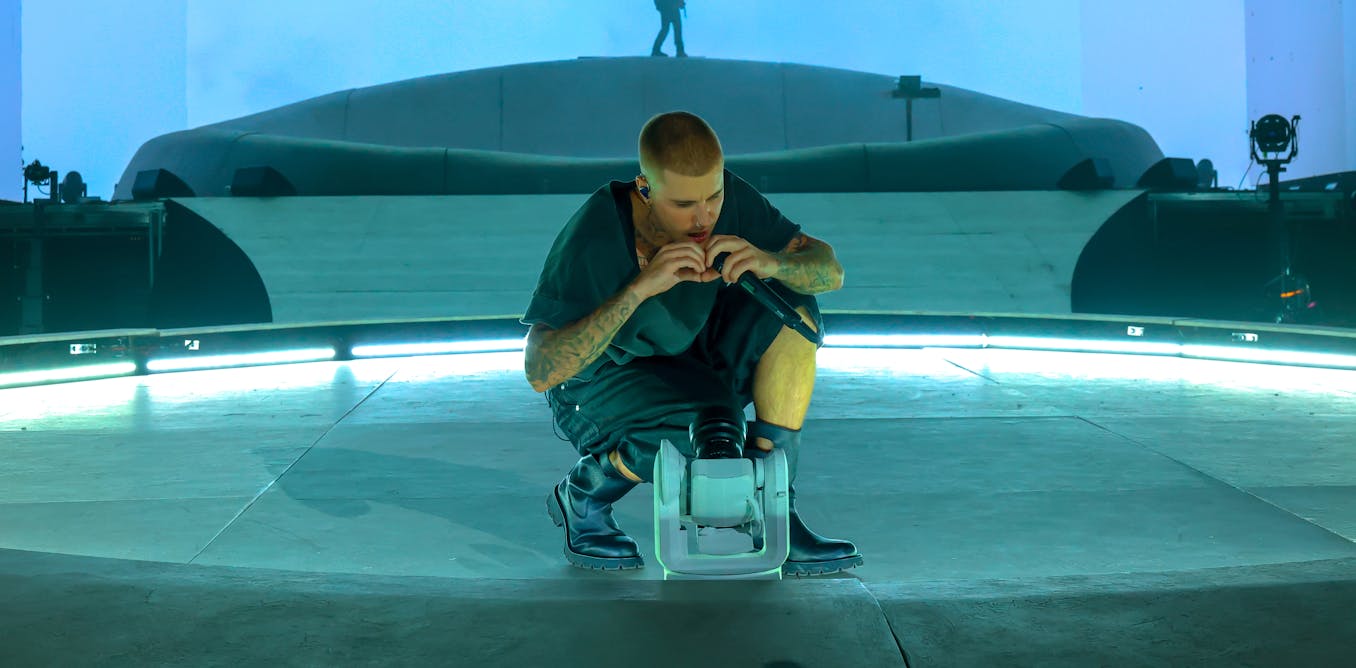
Justin Bieber’s Coachella set challenges traditional ideas of live performance through YouTube nostalgia
 Justin Bieber returned to the stage after a four-year touring break to headline Coachella’s main stage in front of up to 125,000 attendees, with millions more watching the YouTube livestream. While much of his 90-minute set featured typical festival elements including guest appearances from artists like Dijon, Tems, Wizkid, Mk.gee and The Kid Laroi, a controversial 20-minute section divided audiences and critics. Bieber sat at a laptop, searched YouTube on the big screens, and sang along to clips of his early hits such as ‘Baby’ from 2010 and ‘Favorite Girl’ from 2009. He omitted lyrics at times, abruptly cut songs, and moved quickly through snippets including early covers of Chris Brown and Ne-Yo tracks, as well as later hits like ‘Sorry’ and ‘Where Are Ü Now’. He also included personal moments such as a blooper reel and a rant about paparazzi privacy, even feigning a wifi issue. Critics called the segment lazy and disrespectful, but the article’s author, a live-show producer and performance technologies researcher, argues it was a deliberate, rehearsed exploration of ‘liveness’. Bieber engaged with his own viral history and online consumption habits in a relatable way. The piece places the performance in a broader historical context spanning 50 years, referencing acts like The Doors bringing a TV onstage in 1967, Kraftwerk’s robotic personas, Deadmau5 exposing pre-recorded EDM sets, Natalie Cole’s 1992 duet with her late father, and holograms of Tupac at Coachella in 2012 and Maria Callas in 2023. It also notes the influence of platforms like Boiler Room on how online visuals shape live events. Overall, Bieber’s self-referential approach is presented as an innovative contribution to modern performance rather than a shortcut, potentially influencing future shows by blurring the lines between recorded and live elements.